Perfect Pizza Dough
By Culiora
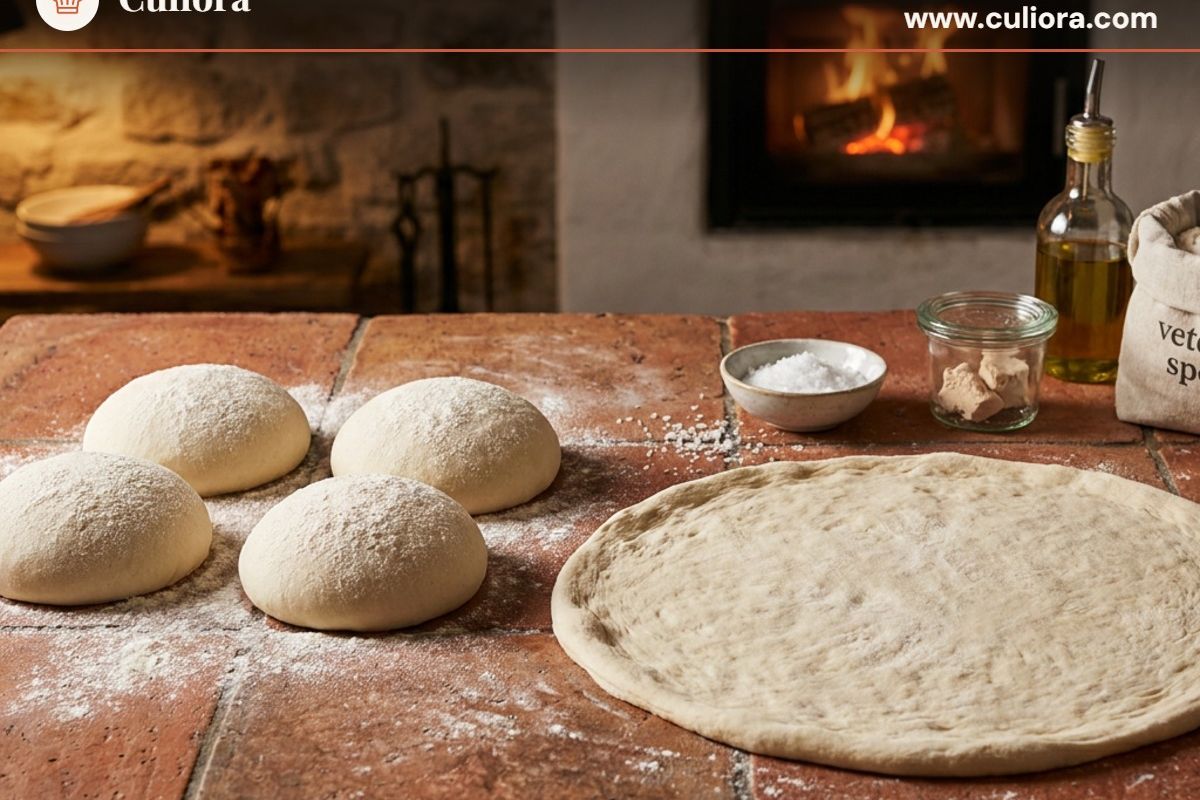
A classic Neapolitan-inspired pizza dough with a crisp base and airy, puffy crust. A slow fermentation develops incredible flavour and makes the dough supple and easy to stretch. The ideal foundation for homemade pizza in a conventional oven or pizza oven.
- Servings: 4
- Prep time: 25 min
- Cook time: 15 min
- Resting/rising: 3 h
- Total time: 3 h 40 min
Ingredients
- 500 g strong bread flour (preferably tipo 00)
- 325 ml water (cold or lukewarm)
- 3 g fresh yeast (or 1 g active dry yeast)
- 12 g fine sea salt
- 10 ml olive oil (optional for standard home ovens)
Instructions
- Measure the cold water into a large mixing bowl. Crumble in the fresh yeast and stir until completely dissolved.
- Add about half of the flour and mix into a thick batter. Add the salt and olive oil, then work in the remaining flour until a cohesive dough comes together.
- Turn the dough out onto a lightly floured work surface. Knead vigorously for 10–12 minutes (or 8–10 minutes in a stand mixer on low speed) until the dough is smooth, elastic, and passes the windowpane test.
- Shape the dough into a smooth, tight ball. Place it in a lightly oiled bowl, cover with plastic wrap or a damp kitchen towel, and let rise at room temperature for 1–2 hours, or in the refrigerator for 24–48 hours for optimal flavour development.
- Divide the dough into 4 equal portions (approx. 210 g each). Shape each piece into a tight, round ball by rolling it against the work surface. Place the dough balls a few centimetres apart on a lightly floured tray, cover tightly, and let rest at room temperature for 2 hours before stretching.
- Preheat the oven to its maximum temperature (at least 250–275 °C conventional heat or broil/grill), preferably with a pizza stone or baking steel on the top rack, for at least 45–60 minutes.
- Dust the work surface with a little Manitoba or semolina flour. Gently press out a dough ball using your fingertips, working from the centre outwards to push the air into the rim, creating a light, airy crust (cornicione). Never use a rolling pin. Top as desired and bake for 5–8 minutes until the crust is puffed and nicely charred in spots.
Tips
- Use Manitoba flour or Italian Tipo 00 flour with a high protein content (at least 12–13%) to build the right gluten structure and elasticity.
- Never roll out the dough with a rolling pin—it presses out all the trapped air pockets from the rim and leaves you with a flat, dense crust. Always stretch and press it gently by hand.
- Cold fermenting in the fridge for 24 to 48 hours breaks down starches, creating a much deeper flavour profile and a more easily digestible pizza crust.
- The recipe makes 4 dough balls of about 210 g each – one ball per pizza.
- Common mistakes are kneading too briefly, using too little salt and baking at too low a temperature. The result is a pale, chewy base instead of an airy, blistered rim.
- Preheat the oven with a pizza stone or steel for 45–60 minutes as described in the method. Each pizza then bakes for about 5–8 minutes; the cooking time assumes several pizzas are baked one after another.
- The stated resting time (3 hours) applies to rising at room temperature. If you choose a cold rise in the fridge, add 24–48 hours.