Sourdough Bread
By Culiora
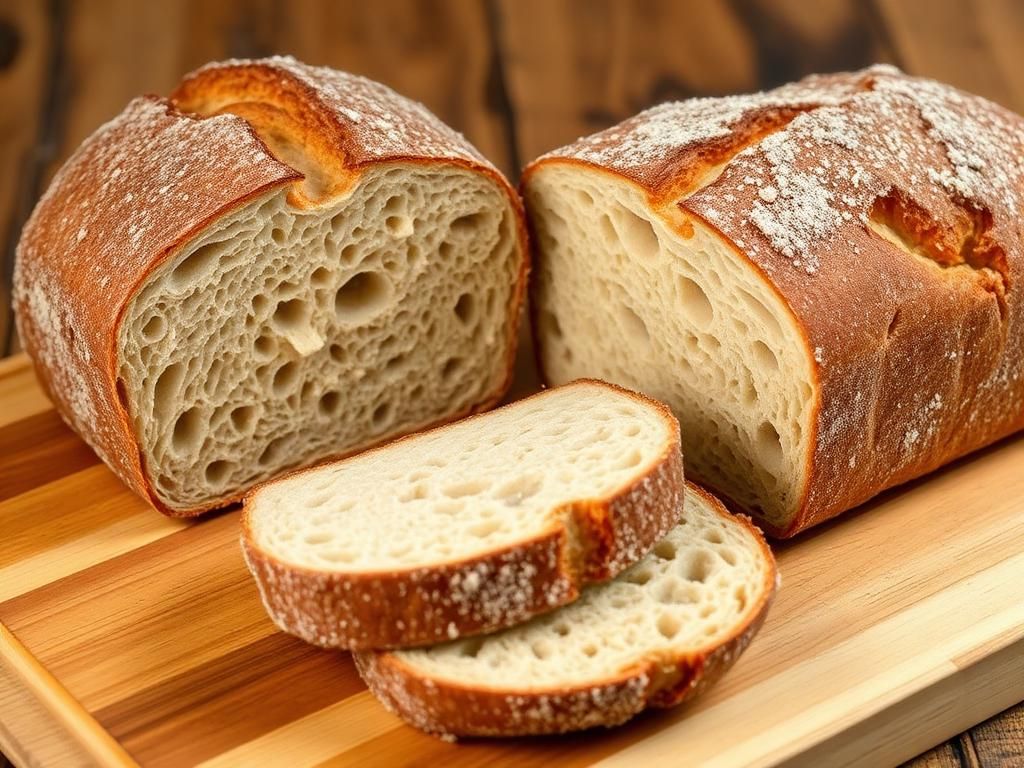
Rustic bread with sourdough and a chewy crust
- Servings: 4
- Prep time: 90 min
- Cook time: 25 min
- Total time: 115 min
Ingredients
- 500 g wheat flour
- 350 g water (lukewarm)
- 100 g active sourdough starter (* see instructions)
- 10 g salt
Instructions
- Mix flour and water in a bowl. Stir to form a dough and let it rest for 30–60 minutes (autolyse).
- Add sourdough starter and salt. Knead the dough until smooth.
- Let the dough rest in the bowl for about 3–4 hours. During this time, fold the dough every 30 minutes (pull the edges and fold over the center).
- When the dough is elastic and airy, transfer it to a floured work surface. Gently shape it into a round or oval loaf.
- Place the dough in a floured proofing basket or a bowl lined with a floured cloth. Let it proof at room temperature for 1–2 hours or in the refrigerator overnight.
- Preheat the oven to 250°C (480°F) well in advance. Place a cast iron pot or baking sheet in the oven to heat up thoroughly.
- Carefully turn the dough out onto parchment paper. Score the surface with a sharp knife.
- Place the bread in the hot pot or on the baking sheet. Bake with the lid on for 20 minutes (or with steam if using a baking sheet).
- Remove the lid and reduce the temperature to 220°C (430°F). Bake for another 15–25 minutes until the bread is golden brown.
- Let it cool completely on a wire rack before slicing.
- * You can get your own sourdough starter going in just three days if you want to get started quickly. Day one, mix 100 grams of flour and 100 grams of lukewarm water in a jar. If you have rye flour at home, it's a good choice to use on the first day as it often kickstarts the process a bit faster, but regular wheat flour also works. Stir to a thick batter, cover the jar loosely so air can enter, and let it sit at room temperature, preferably around 22–25 degrees Celsius.
- Day two, you might start to see small bubbles in the batter, but if you don't, that's perfectly normal. Pour out about half of the contents of the jar, then add another 100 grams of flour and 100 grams of water. Stir well and let it continue to sit at room temperature.
- Day three, there should be clearer activity in the sourdough. You should see bubbles, feel a slightly sour smell, and perhaps notice that the batter increases in volume. Repeat the same process again by discarding half of the batter and feeding it with 100 grams of flour and 100 grams of water. After a few hours, if the sourdough is bubbling clearly and preferably growing in size, it is ready to bake with.
- A finished sourdough starter should smell fresh and sour, not unpleasant, and show clear activity with bubbles. It should preferably double in size after feeding. If you want to speed up the process, you can use a little rye flour, place the jar in a warm place, or stir it an extra time per day.
- It's good to know that a three-day-old sourdough starter works for baking, but the flavor develops and gets better the longer you continue to feed it. If you want to be absolutely sure that the first bread is successful, you can add a small pinch of yeast to the dough the first time.