Canard à l'Orange
By Culiora
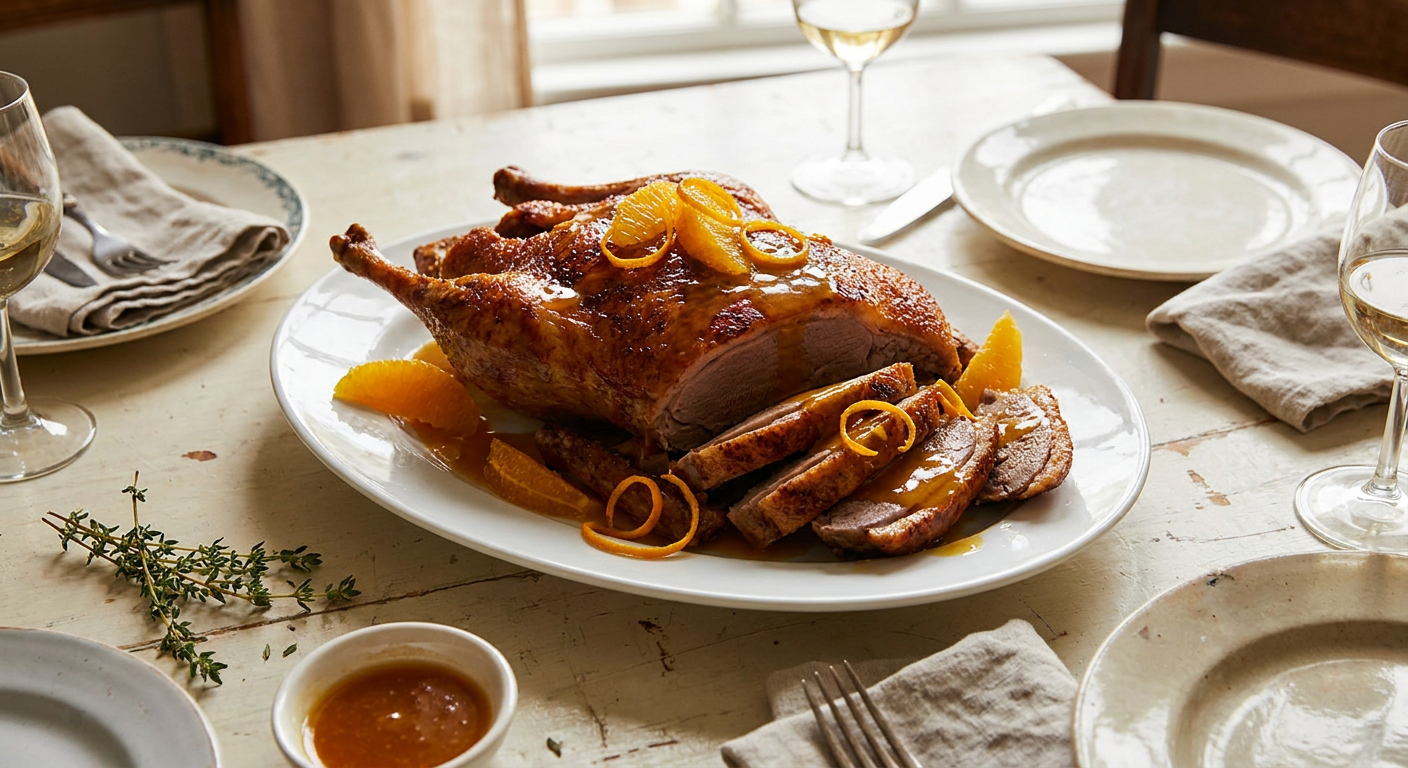
Classic French roast duck served with a glossy bigarade sauce balanced between caramelized sugar, sharp vinegar, and bitter-sweet orange. The skin roasts deeply golden and crisp while rendering plenty of fat, leaving the meat tender and fragrant.
- Servings: 4
- Prep time: 35 min
- Cook time: 90 min
- Total time: 125 min
Ingredients
- 2.2 kg whole duck (cleaned, excess neck skin and wing tips trimmed)
- 1 pcs orange (organic or unwaxed, quartered)
- 2 pcs fresh thyme sprigs
- 1 pcs small yellow onion, quartered
- 1.5 tsp fine sea salt
- 1/2 tsp freshly ground black pepper
- 2 pcs oranges (organic or unwaxed, for zest and juice)
- 1 pcs lemon (for juice)
- 50 g granulated sugar
- 40 ml red wine vinegar
- 400 ml rich dark duck or veal stock
- 30 ml Grand Marnier or Cointreau
- 30 g cold unsalted butter, cubed
- 1 pcs orange (peeled and segmented into suprêmes, for garnish)
Instructions
- Preheat the oven to 175°C. Pat the duck thoroughly dry inside and out with paper towels. Using the tip of a sharp paring knife, gently prick the skin around the thighs, back, and lower breast at a shallow angle, taking care not to pierce the meat underneath.
- Season the duck cavity generously with 1/2 teaspoon of salt and a pinch of black pepper, then stuff with the quartered orange, onion quarters, and thyme sprigs. Rub the remaining salt and pepper all over the exterior skin. Truss the legs snugly with kitchen twine.
- Place the duck breast-side up on a wire rack set inside a roasting pan. Roast in the oven for 1 hour and 15 minutes, basting occasionally with the rendered pan juices and pouring off excess fat into a heatproof bowl every 30 minutes (reserve this fat for later use).
- Increase the oven temperature to 210°C and roast for an additional 15 to 20 minutes, until the skin is deep golden-brown and crisp, and an instant-read thermometer inserted into the thickest part of the thigh reads 75°C. Transfer the duck to a warm carving board, tent loosely with foil, and rest for 15 minutes before carving.
- While the duck roasts, prepare the citrus zest: use a vegetable peeler to remove the zest from the 2 sauce oranges in wide strips, avoiding the white pith. Slice into very fine julienne strips. Blanch the zest in a small saucepan of boiling water for 2 minutes, drain, and rinse under cold water; repeat this blanching once more to eliminate bitterness. Squeeze the juice from the 2 oranges (about 120 ml) and the lemon (about 30 ml).
- Prepare the gastrique: in a heavy-bottomed saucepan over medium heat, combine the sugar and red wine vinegar. Cook without stirring, swirling the pan occasionally, until the mixture bubbles and turns a rich, clear amber caramel, about 5 to 6 minutes.
- Immediately pour in the orange juice and lemon juice to halt the caramelization (caution: the mixture will bubble vigorously and the sugar will briefly seize). Whisk over medium-low heat until the caramel dissolves completely into the citrus juice.
- Pour the duck or veal stock into the saucepan and bring to a simmer. Cook over medium-high heat until the liquid reduces by about half and coats the back of a spoon, about 10 to 12 minutes. Stir in the blanched orange zest and Grand Marnier, simmering for another 2 minutes.
- Remove the sauce from the heat. Whisk in the cold cubed butter one piece at a time until emulsified, glossy, and velvety. Season to taste with a small pinch of salt and pepper. Stir in the fresh orange segments just to warm through.
- Carve the rested duck into breasts and leg portions. Arrange on a warmed platter with the orange segments and pour over a generous ladle of the sauce, serving the remaining sauce in a boat on the side.